Educational Takeaway: Net 250 Points Move Captured in NIFTY_I with VC + TBTS + CR + UA using Bell Orderflow Ultimate

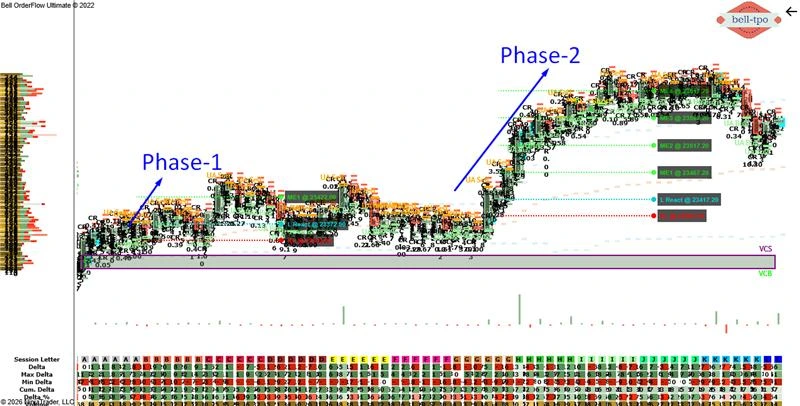
The session provided an excellent example of how VC, TBTS, CR, and UA concepts can work together to identify structured market participation and value migration. By following predefined equilibrium, reaction, and risk levels, traders could observe the market’s progression through multiple phases without relying solely on price movement.
The move unfolded in two distinct phases, beginning with an initial expansion and later developing into a larger directional move supported by continued value acceptance across multiple equilibrium zones.
Maximize Your Trading Edge with Bell Orderflow Ultimate Visit www.belltpo.com or reach out to us for more details.
Phase 1 – 50 Points Move (VC + CR)
ME-1 (Market Equilibrium @ 23422.00)
- ME-1 served as the primary equilibrium reference during the initial phase of the move.
- Price acceptance around this level indicated a balanced transition before further expansion.
- Market Equilibrium levels help traders identify areas where value is being established.
- These zones often act as important references for understanding market structure.
L React (Long Price Reaction @ 23372.00)
- The Price Reaction zone highlighted an area where market participation became increasingly active.
- Price responded efficiently from this level, helping establish the foundation for the phase.
- Price Reaction levels reveal where significant market responses are taking place.
- These zones often provide valuable insight into participant conviction and activity.
RL (Risk Limit @ 23342.00)
- The Risk Limit zone acted as an important boundary for assessing market acceptance and rejection.
- Price behavior around this level provided an early indication of the developing structure.
- Risk Limit levels help traders define critical areas where participation dynamics may change.
- Monitoring these zones improves understanding of market control and directional intent.
Phase 2 – 200 Points Move (VC + TBTS + CR + UA)
RL (Risk Limit @ 23387.20)
- The Risk Limit zone marked the beginning of a larger expansion phase and served as a key structural reference.
- Price interaction around this level reflected increasing participation and value migration.
- Risk Limit zones are important because they help identify the transition from balance to expansion.
- These references provide context for evaluating changing market conditions.
L React (Long Price Reaction @ 23417.20)
- The Price Reaction zone became the first major participation area within the larger move.
- Price respected this level and continued building structure around it.
- Reaction zones help traders understand where active market engagement is occurring.
- These levels frequently become reference points throughout the trading session.
ME-1 (Market Equilibrium @ 23467.20)
- ME-1 represented the first equilibrium transition after the reaction phase.
- Price acceptance around this area confirmed the continuation of value migration.
- Equilibrium zones help identify where the market is establishing fair value.
- Tracking these levels provides insight into evolving market structure.
ME-2 (Market Equilibrium @ 23517.20)
- ME-2 acted as another important balance area during the move.
- The market continued to respect equilibrium transitions while maintaining directional efficiency.
- Market Equilibrium levels provide objective references during fast-moving conditions.
- They help traders evaluate whether value continues to migrate.
ME-3 (Market Equilibrium @ 23567.20)
- ME-3 highlighted continued acceptance at higher value regions as the session progressed.
- Price maintained orderly behavior while interacting around this equilibrium zone.
- These equilibrium references help traders understand participation strength.
- Consistent acceptance across multiple equilibrium zones often reflects healthy market structure.
ME-4 (Market Equilibrium @ 23617.20)
- ME-4 marked the final major equilibrium level within the move.
- The market continued respecting balance areas while maintaining strong directional organization.
- Final equilibrium zones often provide insight into whether value migration remains intact.
- Observing price behavior around these levels helps traders prepare for future sessions.
Conclusion
This session showcased how VC, TBTS, CR, and UA concepts can work together to provide a structured framework for understanding market behavior. Rather than reacting emotionally to market fluctuations, traders could observe equilibrium shifts, reaction zones, and risk boundaries to interpret participation and value migration objectively. Bell Orderflow Ultimate enables traders to visualize these critical market dynamics in real time, helping them better understand structure, balance, and participation during evolving market conditions.Maximize Your Trading Edge with Bell Orderflow Ultimate Visit www.belltpo.com or reach out to us for more details.