Educational Takeaway: Net 70 Points Move Captured in NIFT_Y with VC + TR + TBTS + UA + CR using Bell Orderflow Ultimate

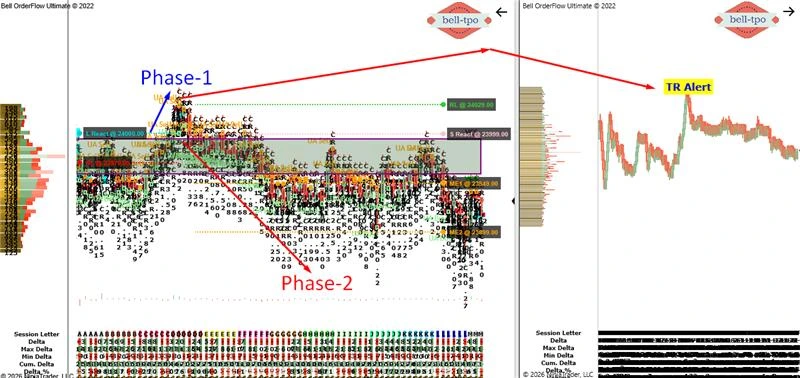
Today’s session demonstrated how Bell Orderflow Ultimate identified multiple high-probability market locations through the combined strength of VC, TR, TBTS, UA, and CR. The market first reacted at a key defensive zone before developing into a directional move that offered a total opportunity of approximately 70 points.
Maximize Your Trading Edge with Bell Orderflow Ultimate Visit www.belltpo.com or reach out to us for more details.
Phase 1: 30 Points Risk Limit Interaction (VC + CR)
L React (Long Price Reaction @ 24000.00)
- The Long Price Reaction level highlighted a critical area where responsive activity emerged and attempted to defend the prevailing structure. This level served as an important reference point for assessing market participation and potential continuation.
- Price Reaction levels help traders identify zones where opposing participants actively engage, often leading to short-term directional responses. These areas frequently become valuable reference points throughout the trading session.
RL (Risk Limit @ 23970.00)
- The Risk Limit level represented the maximum acceptable adverse movement from the reaction zone before the original premise became invalid. Monitoring this level allowed traders to objectively evaluate whether the market structure remained intact.
- Risk Limit levels are designed to define risk boundaries clearly and eliminate emotional decision-making. They provide a structured framework for assessing whether a setup continues to maintain its statistical edge.
Phase 2: 100 Points Directional Move (TR + TBTS + CR + UA)
RL (Risk Limit @ 24029.00)
- A fresh Risk Limit level was established as new order flow conditions developed. This level acted as the reference boundary for evaluating the validity of the emerging market structure.
- By identifying Risk Limits dynamically, Bell Orderflow Ultimate helps traders adapt to changing market conditions while maintaining disciplined risk management principles.
S React (Short Price Reaction @ 23999.00)
- The Short Price Reaction level highlighted a key area where market participants began responding aggressively. This reaction provided early evidence of a potential directional expansion developing within the session.
- Price Reaction zones often serve as the starting point for larger moves when supported by additional order flow confirmations. Their significance increases when multiple Bell Orderflow concepts align at the same location.
ME-1 (Market Equilibrium @ 23949.00)
- Market Equilibrium levels represent areas where price seeks balance between opposing participants before deciding on the next directional move. These zones frequently act as natural magnets during trending conditions.
- ME levels provide traders with objective reference points for monitoring market acceptance and continuation. Sustained movement beyond equilibrium often indicates increasing directional conviction.
ME-2 (Market Equilibrium @ 23899.00)
- The second equilibrium level acted as an additional market balancing zone during the expansion phase. As price approached this area, it provided valuable insight into whether momentum remained intact.
- Multiple equilibrium levels help traders map the market’s internal structure and understand how price transitions from one value area to another. These levels often become important references for future sessions as well.
Conclusion
This session showcased how Bell Orderflow Ultimate combined VC, TR, TBTS, UA, and CR to identify important market reference levels throughout the day. By utilizing Price Reaction levels, Risk Limits, and Market Equilibrium zones, traders could objectively track market structure and understand how price evolved from one phase to the next. The focus remains on reading market-generated information and responding to evolving order flow conditions rather than relying on predictions.Maximize Your Trading Edge with Bell Orderflow Ultimate Visit www.belltpo.com or reach out to us for more details.