Educational Takeaway: Net 90 Points Move Captured in NIFTY_I with VC + TBTS + CR + UA using Bell Orderflow Ultimate

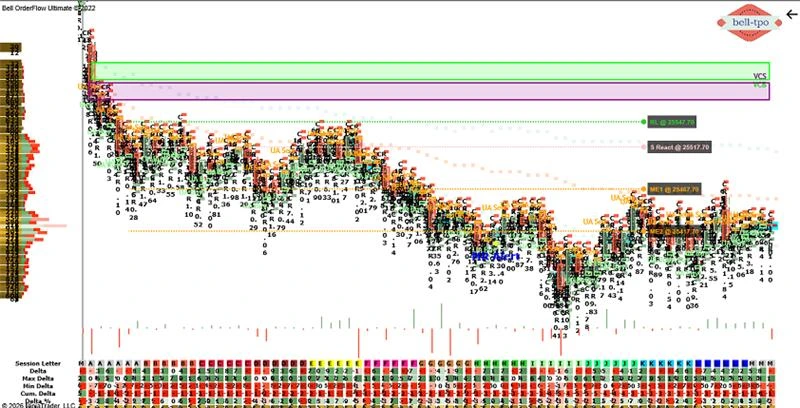
In this session NIFTY_I delivered a structured 90-point directional move driven by Volume Clusters, trapped positioning, Cot Ratio imbalance, and auction inefficiencies. However, the most important learning from this session was not just the expansion — it was the proper handling of the MR Alert. This blog focuses on both the structured move and the discipline required while trading MR Alerts effectively.
Maximize Your Trading Edge with Bell Orderflow Ultimate Visit www.belltpo.com or reach out to us for more details.
Phase 1 – Structured Downward Expansion
(VC + TBTS + CR + UA Alignment)
The first phase unfolded with strong cluster confirmation and trapped positioning imbalance.Risk Limit (RL @ 25547.70)
- This level defined the structural invalidation boundary for Phase 1.
- Holding below this level confirmed that initiative activity remained dominant.
- Risk Limit acted as the capital protection anchor.
- Any acceptance beyond it would have indicated structural shift.
S React – Short Price Reaction (@ 25517.70)
- This reaction level marked the first aggressive response after structure confirmation.
- It reflected active participation aligning with trapped positioning.
- The reaction validated initiative continuation from the cluster zone.
- Orderflow imbalance remained consistent at this level.
ME-1 – Market Equilibrium (@ 25467.70)
- ME-1 acted as the first balance checkpoint during expansion.
- Smooth acceptance below it signaled continuation strength.
- This level provided structured rotation reference.
- Failure to rotate above it maintained directional pressure.
ME-2 – Market Equilibrium (@ 25417.70)
- ME-2 represented extended distribution in the auction cycle.
- Continuation below this equilibrium confirmed expansion maturity.
- It functioned as a secondary structural checkpoint.
- Sustained movement through it reflected strong imbalance control.
Phase 2 – MR Alert Failure & Risk Discipline
How to Trade MR Alert Effectively
1. MR Requires Context
An MR Alert works best:- Near exhaustion zones
- Around equilibrium levels
- When delta divergence supports reversal
2. Structure Before Signal
If structure breaks immediately after the alert:- It indicates absorption failure
- Or continuation strength overpowering reversal
3. Risk Limit Is Non-Negotiable
- MR setups require tight and predefined risk control.
- Once the Risk Limit is breached, continuation probability dominates.
- Discipline here protects capital and preserves earlier gains.
4. Confluence > Standalone Alert
MR performs significantly better when combined with:- VC exhaustion
- TBTS positioning shift
- CR weakening
- UA confirmation
Core MR Principle
MR Alert is a potential momentum shift indication, not a prediction. Confirmation + Structure + Risk Discipline define its effectiveness.Conclusion
The 90-point move in NIFTY_I was a textbook example of:- Cluster-based imbalance
- Trapped positioning fuel
- Cot Ratio alignment
- And disciplined MR Alert handling
Maximize Your Trading Edge with Bell Orderflow Ultimate Visit www.belltpo.com or reach out to us for more details.