Educational Takeaway: Net 220 Points Move Captured in NIFTY_I with VC + TBTS + MR + UA + CR using Bell Orderflow Ultimate

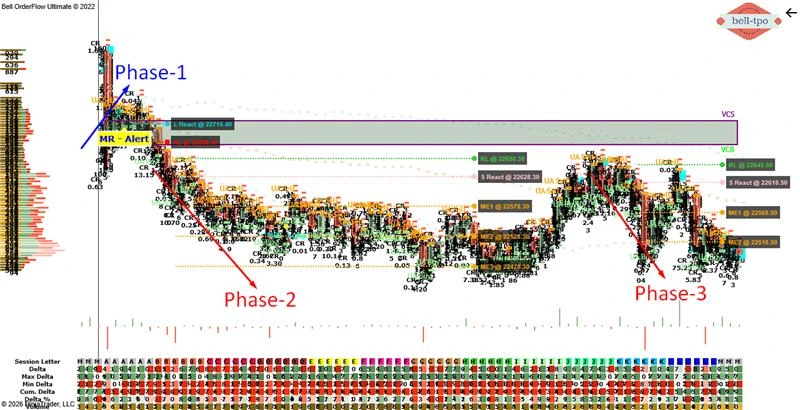
This case study highlights a 220-point structured move in NIFTY_I, driven by a confluence of VC, TBTS, MR, UA, and CR signals. The phases demonstrate how price consistently respected Market Equilibrium (ME), Reaction levels, and Risk Limits (RL), offering a rule-based framework for understanding market behavior.
Maximize Your Trading Edge with Bell Orderflow Ultimate Visit www.belltpo.com or reach out to us for more details.
Phase 1: 30 Points Risk Limit Hit
ME Levels
- No Market Equilibrium levels were formed in this phase, indicating a lack of structured continuation. This reflects a short-lived move where price did not establish balance.
- The absence of ME zones highlights an unstable environment. It emphasizes the importance of waiting for structured setups before expecting continuation.
L React (Long Price Reaction @ 22716.40)
- The long price reaction indicated an attempt to push price higher from this level. It showed initial responsiveness but lacked sustained momentum.
- This reaction remained isolated without structural support. It reflected a temporary response rather than a strong phase.
RL (Risk Limit @ 22686.40)
- Risk Limit was triggered quickly, marking the invalidation of the setup. It defined the boundary beyond which the structure failed.
- This level reinforced disciplined risk management. It ensured early identification of weak or unstable conditions.
Phase 2: 150 Points Short Move (VC + CR + UA)
ME-1 to ME-3 (22578.30 → 22478.30)
- A clear sequence of Market Equilibrium levels formed a structured pathway for the move. Price transitioned smoothly across these levels, indicating sustained control.
- These ME levels acted as checkpoints where balance was briefly established before continuation. Their alignment confirmed a strong and organized phase.
S React (Short Price Reaction @ 22628.30)
- The short price reaction confirmed strong participation at higher levels. It aligned with the continuation of the broader structure.
- This reaction level acted as a trigger for momentum. It highlighted active pressure supporting the move.
RL (Risk Limit @ 22658.30)
- Risk Limit defined the upper boundary, ensuring clarity in structure. It marked the threshold beyond which the phase would weaken.
- This level acted as a control point for maintaining discipline. It reinforced structured tracking of price behavior.
Phase 3: 100 Points Short Move (TBTS + CR)
ME-1 & ME-2 (22568.50 → 22518.50)
- Market Equilibrium levels provided a continuation framework where price moved systematically. These levels acted as structured reference zones within the phase.
- They also indicated areas of temporary balance before further movement. Their presence confirmed a well-defined and controlled structure.
S React (Short Price Reaction @ 22618.50)
- The short price reaction showed renewed pressure at higher levels. It aligned with the continuation of the overall structure.
- This reaction level helped validate momentum within the phase. It reflected active participation supporting the move.
RL (Risk Limit @ 22648.50)
- Risk Limit defined the upper boundary, ensuring the structure remained controlled. It marked the point beyond which the phase would lose validity.
- This level reinforced disciplined execution. It ensured clarity in identifying structural limits.
Key Learning
- Strong moves are often supported by sequential ME levels, acting as a roadmap.
- Reaction levels highlight where price responds with momentum and participation.
- Risk Limits are essential for defining structure and managing invalidation.
- Phases without ME levels often indicate weak or short-lived conditions.
Maximize Your Trading Edge with Bell Orderflow Ultimate Visit www.belltpo.com or reach out to us for more details.