Educational Takeaway: Net 70 Points Move Captured in NIFTY_I with VC + TR + CR using Bell Orderflow Ultimate

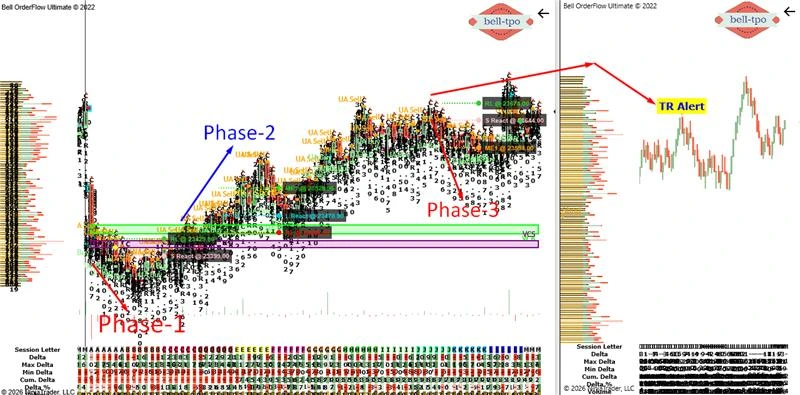
The session in NIFTY_I demonstrated how structured orderflow reactions can provide high-probability trading opportunities when combined with disciplined risk management. Using Bell Orderflow Ultimate, multiple phases of market participation were identified through VC, TR, and CR-based reactions, helping traders understand directional intent and equilibrium behavior without emotional decision-making.
Maximize Your Trading Edge with Bell Orderflow Ultimate Visit www.belltpo.com or reach out to us for more details.
Phase 1 – 30 Points Risk Limit Hit
Key Levels
- RL (Risk Limit @ 23429.00)
- S React (Short Price Reaction @ 23399.00)
Understanding Risk Limit (RL)
- Risk Limit levels act as predefined protection zones that help traders understand where momentum strength may weaken or where volatility expansion can occur. These levels are designed to maintain trading discipline by defining structured invalidation areas during live market conditions.
- RL zones also help traders avoid emotional execution by providing objective reference points. When price reacts strongly around these areas, it often reflects aggressive participation and liquidity response from larger market participants.
Understanding Price Reaction Levels
- Price Reaction zones are areas where the market responds sharply due to imbalance between opposing participants. These reactions often indicate strong participation and can help traders understand short-term directional intent.
- Reaction levels become more reliable when combined with confirmation tools such as VC, TR, or CR concepts. Sustained movement from these zones frequently reflects institutional activity and momentum continuation.
Phase 2 – 50 Points Long Move (VC + CR)
Key Levels
- ME-1 (Market Equilibrium @ 23520.90)
- L React (Long Price Reaction @ 23470.90)
- RL (Risk Limit @ 23440.90)
Understanding Market Equilibrium (ME) Levels
- Market Equilibrium levels represent fair value zones where opposing participants temporarily agree on price. These areas often act as balance points before the market decides its next expansion phase.
- ME levels are highly useful for identifying pauses, rotations, and continuation behavior during trending sessions. Strong acceptance or rejection around equilibrium levels can provide deeper insight into market sentiment.
Phase 3 – 50 Points Short Move (TR + CR)
Key Levels
- RL (Risk Limit @ 23674.00)
- S React (Short Price Reaction @ 23644.00)
- ME-1 (Market Equilibrium @ 23594.00)
Conclusion
This NIFTY_I session highlighted how VC, TR, and CR concepts within Bell Orderflow Ultimate can help traders identify structured market opportunities through equilibrium zones, reaction levels, and disciplined risk management. Instead of relying on assumptions, traders can focus on objective orderflow behavior and price participation to improve market understanding.Maximize Your Trading Edge with Bell Orderflow Ultimate Visit www.belltpo.com or reach out to us for more details.